


September 3, 2026 | Articles
Maggie Gallagher & Hill International’s Next Generation of Construction Management Excellence

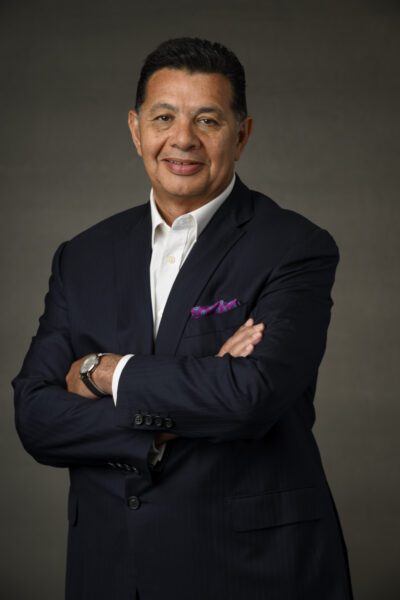
“Our company started small, with Irv Richter consulting on claims out of his home in 1976,” says Raouf S. Ghali, Hill International’s Chief Executive Officer. “We’ve since grown to become one of the world’s top program, project, and construction management firms—a firm that has pioneered consultancy services, embodied excellence in project and construction management, led award-winning projects to on-time and on-budget completion, and transformed the communities we serve for half a century.”
Few current Hill employees have the tenure to discuss Hill’s 50-year story like Raouf, who has been with the company since 1993. As an employee and a company leader for more than 30 years, Raouf has been directly involved with many of the momentous events that have shaped our legacy, including the delivery of high-profile projects globally, key acquisitions that allowed Hill to enter new markets and geographical regions, the process of going public, and Hill’s acquisition by Global Infrastructure Solutions Inc. (GISI) in 2022. Raouf has also been with the company through tumultuous periods, such as the Great Recession, the Arab Spring, and the COVID-19 pandemic. “Looking back at all the memories, both the highlights and the most challenging times, I feel incredibly proud of where Hill is today,” he says.
One prominent memory for Raouf involves his earliest days with Hill. Shortly after joining the company as Vice President, he was tasked with growing Hill’s international project and construction management operations. Of Hill’s approximately 250 employees at the time, only 12 worked in the international group. Leveraging his skills in business development, project management, financial analysis, contract management, and team building, Raouf helped develop and implement a plan for achieving sustainable international growth.
“We established two objectives,” explains Raouf. “First, we wanted to leverage our existing project and construction management presence in the UAE to expand our operations throughout the Middle East. We also saw an opportunity to enter Europe via the Southeastern European infrastructure market. Even though we had a small team, we had a strong team, and we were successful in both regions.”
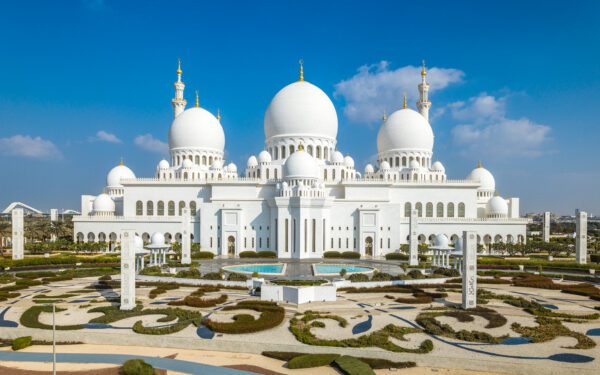
Raouf calls Hill’s work on the Sheikh Zayed Grand Mosque in Abu Dhabi a key starting point. In 1997, Hill was selected to provide project management services for the design and construction of the Grand Mosque, one of the world’s largest mosques. Raouf set up initial project management disciplines and helped oversee design and construction works for the award-winning project.
According to Raouf, Hill’s efforts on the high-profile Grand Mosque project gave our company a reputation for effectively managing complex construction. This led to new work by helping us develop professional relationships with other potential clients in the region. One of the most important for Hill’s subsequent growth was our relationship with Nakheel, a state-owned real estate developer in Dubai. After winning a role and demonstrating our value on one of Nakheel’s residential construction projects, the developer selected Hill to provide project management services for the project of a lifetime: Palm Jumeirah.
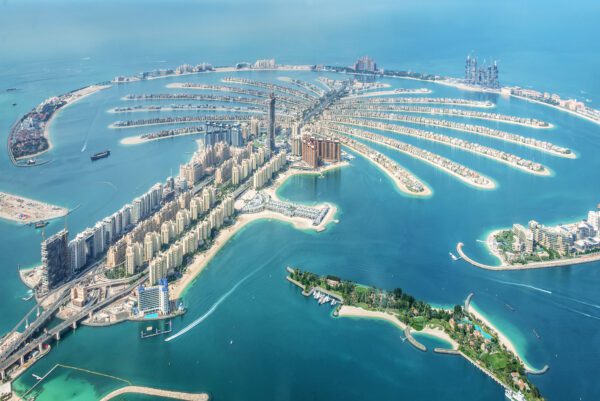
Palm Jumeirah is an iconic artificial island in the shape of a date palm tree located just off the coast of Dubai. With a “trunk,” “fronds,” and an outer crescent breakwater featuring apartment buildings and hotels, single-family homes, private beaches, as well as entertainment, retail, and dining facilities, Palm Jumeirah was a one-of-a-kind endeavor that put Hill’s international reputation for project and construction management into a different league not just in the Middle East, but around the world.
Meanwhile, in Southeastern Europe, Raouf helped Hill break into Romania’s infrastructure market. The Romanian Ministry of Development selected Hill to develop a process for selecting and launching complex infrastructure projects in line with European Union standards. Raouf directed the Hill team that helped Romanian authorities conduct technical, economic, and environmental analyses to select the most impactful projects for implementation, improving daily life for millions of people throughout the country, supporting Romania’s efforts to join the European Union, and catalyzing Hill’s growth throughout Europe.
Raouf attributes his team’s success in the UAE and Romania—two very different markets—to Hill’s approach to doing business internationally. “We have global expertise and a unique way of doing things, but we adapt to each marketplace we serve and the local culture there, applying international best practices in a way that respects our clients and their stakeholders,” he says.
Hill’s international growth around the turn of the millennium defined a new epoch for the company. While Hill had always operated internationally, our work on the Palm Jumeirah and other high-profile projects in the Middle East and our entrance into the Southeastern European infrastructure market helped transform Hill into the internationally renowned program, project, and construction management firm we are today. “We started with 12 people in the international group in 1993,” says Raouf. “By 2004, we had more than 1,000 working on impactful, complex, and high-profile projects in Europe and the Middle East. Our team’s success remains a tremendous source of pride for me.”
Over the years, Raouf continued to take on new leadership roles at Hill. He served as Senior Vice President from 2001 to 2004, President of Hill’s international project and construction management group from 2005 to 2015, and President and Chief Operating Officer from 2015 to 2018. Since 2018, he has been at the helm as CEO. Under Raouf’s regional and company-wide leadership, Hill has weathered complex challenges associated with international economic, social, and health crises. “To survive the most challenging periods, we prioritize our people,” he says.
For example, when the Arab Spring began in the early 2010s, Hill was operating throughout North Africa. In the uncertain early days of the uprisings, Raouf and the rest of Hill’s leadership team immediately took steps to protect our staff. “We were one of the first companies, if not the very first, to evacuate all of our employees from Libya,” says Raouf. “In one month, we had chartered planes and transported all of our staff out of North Africa. It went smoothly, and nobody on our team got hurt. In fact, because we reacted so quickly, several embassies reached out to Hill to help them get their own people out of the region.”
Hill reacted just as quickly as the situation on the ground continued to change. Within three months, when Raouf and regional leadership determined it was safe to do so, Hill employees were back working on projects in multiple North African countries. “As a pure-play project management firm, we’re smaller than our biggest competitors,” Raouf says. “A smaller organization allows us to make decisions more quickly and more flexibly adapt to changing circumstances on a region-by-region basis. That was crucial during the Arab Spring.”
A similar story played out during COVID-19. By that time, Raouf had become CEO. In the early days of the pandemic, Hill rapidly shifted to remote work. Raouf emphasizes that, despite uncertainty, Hill also maintained most of our staff. “By moving quickly to end leases and reduce other direct costs, we kept most of our staff employed, even when their projects had shut down,” he says. “Later on, we also allowed employees to roll over extra paid-time off accrued during 2020 into 2021 as an accommodation. Even though these decisions temporarily impacted our financial performance, Hill’s leaders thought it was more important to support our employees through pandemic-related disruptions.”
Keeping staff employed benefited the business too. “Many of our competitors had layoffs,” Raouf says. “Since we didn’t, when the market came back and projects restarted, we were ready to deploy our teams immediately. Our clients appreciated that.”
All of his experiences, positive and negative, have shaped Raouf’s leadership approach and outlook on Hill International’s future. Where is the company going as we enter our 50th year? “We aim to be the first choice for project and construction management on large, complex construction programs around the world,” Raouf says. “We’re not going to be the biggest project and construction management company, but we are going to be the most efficient and the most caring. That’s how we will continue to prove our value and achieve sustained profitability.”
Raouf also plans to lean into synergistic opportunities with our GISI Consulting Group sister companies. He expects new cross-company leaders like Bryan Benso (Gafcon) and Abdullah Alnabhan (Palladium) to facilitate opportunities for building cross-company teams and driving mutual growth in markets around the world.
However, Raouf stresses that most of the forces behind our continued growth will be characteristically “Hill”: small but strong teams that adapt international project and construction management best practices to the markets we serve, regional units with the flexibility to act quickly in response to changing and challenging conditions, and leadership with an employee- and safety-first ethos.
“Hill is going to keep doing many of the things we have always done,” Raouf goes on. “For example, when there is a problem on our clients’ projects, Hill does two things. First, we figure out how to solve it. Then, we find and bring in resources needed to do so. And since we are a pure-play project and construction management firm, clients can trust that we’re proposing the best possible experts to deliver their projects as envisioned, not just plugging our staff.”
Finally, Raouf mentions prioritization of professional development as a crucial piece of his long-term vision for the company. He cites resources like the award-winning Hill University, an online platform catering to employees’ career growth, as well as Hill’s culture of mentorship and our partnerships with higher education institutions, all of which help ensure a steady stream of qualified in-house staff ready to step into leadership roles on Hill’s project teams and corporate groups—as Raouf once did himself.
New project wins and outstanding project performance evidence the impact of Raouf’s leadership approach globally. Over the past few years in the U.S., for example, Raouf and our Americas team have prioritized and achieved growth via some of the country’s most remarkable megaprojects, including the Washington State Ferries System Electrification Program in Seattle and the Nashville Yards mixed-use development in Nashville, as well as work at Ontario International Airport, LA Metro’s K-line, and our continued growth on the Gold Line Light Rail Program in the Los Angeles area. By continuing to target, win, and effectively manage megaprojects like these in rail and transit, aviation, energy, and other sectors throughout the U.S. and around the world, Raouf plans to pen a new chapter in Hill International’s story during our company’s 50th year.
“Hill’s story, and my own, would not have been possible without my current and former colleagues, as well as all of our predecessors” Raouf says. “So, I’d like to thank everyone who has ever been a Hill employee, as well as our clients, our partners, and all those who have been a part of our story. Together, we have delivered the infrastructure of change safely, on time, and on budget for 50 years—and we’re just getting started.”
Share
September 3, 2026 | Articles
Maggie Gallagher & Hill International’s Next Generation of Construction Management Excellence

August 25, 2026 | Articles
Saudi Arabia Could Become the World’s Largest Project Management Academy

August 2, 2026 | Articles

July 27, 2026 | Articles

June 28, 2026 | Articles
Over It, Under It, & Through It: Navigating Complexity on Mixed-Alignment Rail Programs

June 21, 2026 | Articles
Kalypso Kyriakopoulou on Hill International’s Growth in Europe

May 8, 2026 | Articles


