


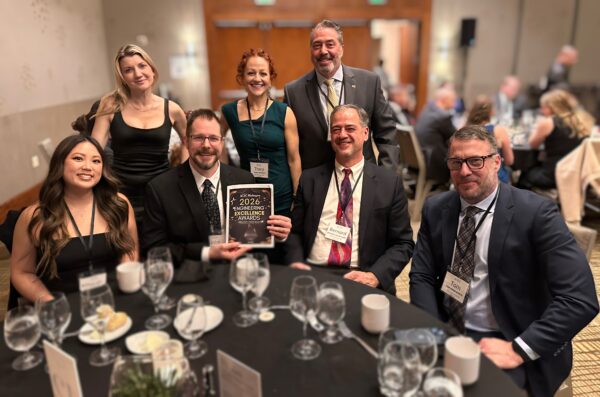
The Shore‑to‑Vessel Charging System (SVCS), the first major infrastructure component of the Washington Department of Transportation (WSDOT) Washington State Ferries’ (WSF) System Electrification Program (SEP), has earned an American Council of Engineering Companies (ACEC) Washington State Engineering Excellence Award, the Best in State Gold Award in the “Future Value to the Engineering Profession and Enhanced Public Awareness/Enthusiasm for the Role of Engineering” category. Hill International is the program manager for the general engineering consultant (GEC) team that supports the SEP.
The largest program of its kind in the nation, the SEP encompasses the delivery of 16 new hybrid-electric vessels, the conversion of 6 existing diesel vessels to hybrid-electric vessels, and the electrification of 16 terminals throughout Washington’s Puget Sound and adjacent waters. In addition to slashing carbon emissions and delivering a more sustainable state transit system, the program will improve service reliability, boost the state’s economy, and contribute to better health for residents.
An Innovative Design Solution
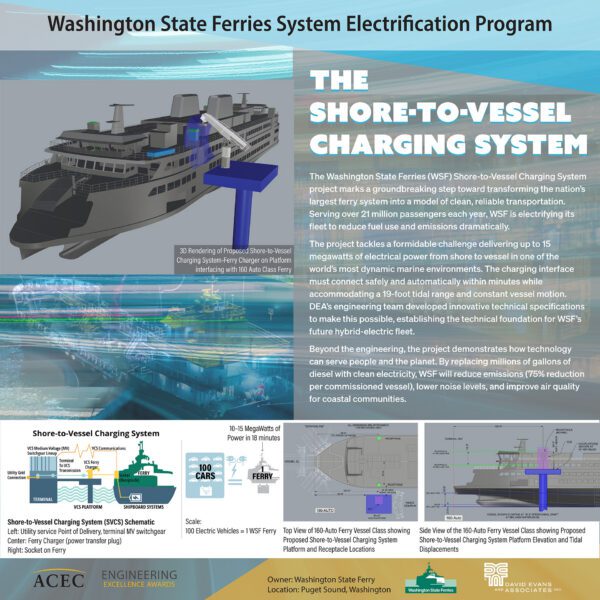
The SVCS project involves the delivery of a medium‑voltage charging interface for the first five terminals to be electrified as part of the SEP. The charging interface must be able to provide up to 15 megawatts of power within a 20-minute docking window. The interface also has to be suitable for multiple vessel classes and capable of reliable operation within Puget Sound’s challenging conditions, including tidal variations of up to 19 feet, continuous vessel movement, and utility grid constraints. As no available commercial charging system meets the requirements for the SVCS, WSF required an innovative design solution.
The Hill-led GEC includes David Evans and Associates (DEA), the principal designer for the SVCS project. Leveraging advanced three-dimensional motion analysis and the multi-disciplinary engineering expertise of their team, DEA established allowable movement limits for connecting and charging vessels, as well as other innovative technical specifications and overall system performance standards. Their charging system provides a key design solution that integrates vessels, terminals, and grid infrastructure in line with WSF’s requirements. This enables the SVCS—and the SEP—to move forward as planned.
Coordinating Collaboration
As program manager for the overall SEP, one of Hill’s key responsibilities on the SVCS project was facilitating collaboration on the project’s design team and with third-party utilities. Working closely with WSF, we have also provided project controls, schedule management, environmental planning, coordination, and other services to promote the consistent delivery of technical, operational, and regulatory components on the SVCS project and across the program.
With Hill’s support, DEA coordinated the efforts of a large group of engineering firms to deliver their design solution. Elliott Bay Design Group provided marine architecture, electrical, and mechanical engineering services. Mott MacDonald supported terminal engineering. Hildreth Energy analyzed life cycle costs. Other project partners contributed to electrical design, utility coordination, naval architecture, and terminal planning. WSF staff were also closely involved throughout design to help ensure alignment with system needs.
Additionally, the entire project team coordinated with five regional utilities to evaluate grid capacity, system characteristics, and load-management requirements for the new charging system. By establishing grid constraints and channels of communication with key utility stakeholders, this coordination effort provides an essential foundation for the electrification of all WSF’s terminals in the coming years.
Recognizing an Impactful Project
ACEC’s Engineering Excellence Award recognizes the technical achievement, coordination, and planning behind the SVCS. Hill International congratulates WSDOT and WSF, DEA, and the full GEC team on this well‑deserved recognition and the project progress to date.
“The SVCS is a crucial step towards system electrification, which supports Washington’s long‑term environmental objectives,” says Hill Vice President Bernard van de Kamp. “The whole project team has done a fantastic job overcoming the challenges associated with designing this infrastructure. We’re proud of our involvement, and look forward to working with the program team and WSF to deliver the rest of the SEP as planned.”
Learn more about the SEP here: https://www.hillintl.com/project/washington-state-ferries-system-electrification-program/.
Share

March 17, 2026 | Articles
Hill International to Provide Independent Engineering Services for Highway Megaproject in Crete

March 5, 2026 | Articles
Celebrating Women in Construction Week With Hill Advisory’s Chioma Iwuagwu

March 5, 2026 | Articles
Building Complex Infrastructure & Tomorrow’s Construction Leaders at the Port of Seattle

January 29, 2026 | Articles
Hill’s Efficient, Flexible, & Partnership-Rooted Advisory Approach

January 13, 2026 | Articles

December 31, 2025 | Articles
Abdullah Alnabhan Joins Hill International as Managing Director, Middle East


